Hello
My name is Zoe. A Retail Sales Manager with 10 years of experience who fell in love with the art of Product Management and User Experience. I am passionate about discovering customers' underserved needs, and delivering delightful products and customer experience.
Product Management Projects
Part of Product Management learning practice, I worked on 4 projects and the 2 of them were with the real clients.Key achieved outcomes:
- New business model canvas
- Market and competitor analysis
- User personas and customers' JTBDs
- User journey maps
- Product UVPs
- Metrics
- Product roadmaps
- Testing prototypes
- User stories and key acceptance criteria for backlog
Neobanking app

TrainHeroic app

Real client project - Healthtech

Real client project- Social Enterprise

About ME
During my time as retail operations manager at IKEA Australia, I was fortunate to closely collaborate with executives, co-workers and customers. My team exceeded expectations for performance while creating an engaging work environment.After leading projects to implement new operational tools for my sales team, I became interested in product management due to the direct customer impact and potential scalability of well-designed products. To further pursue this passion, I recently completed an intensive 6-month product management certification course with Academy Xi.I have enhanced my skills in user-centric design, practical prioritisation, flexible communication, and creative problem-solving. I am now seeking to apply these skills in a product management role. My objective is to create products that not only simplify people's lives but also bring joy through simplicity and meeting consumer needs. While I acknowledge that there is still much to learn in this field, I am enthusiastic about the opportunities to collaborate with talented colleagues in developing products that users will value.
Tech stack:
- MS Office
- Gsuits
- Trello
- Jira
- Figma (in progress)
- SQL (in progress)
- HTML (in progress)
Contact
I'm thrilled to extend an open invitation to connect and chat about all things product management, self-development, or even the mind-bending concepts explored in the latest Huberman Lab podcast episode.As a PM on a relentless quest to learn and grow, I'm always up for a virtual coffee session to swap ideas, share experiences, and maybe even unravel new thoughts and ideas, especially the art of asking the right questions (over a cup of coffee, of course).Let's embark on a journey of knowledge and inspiration together. Feel free to reach out, and let's foster connections that are vibrant as our shared passion for innovation and learning.Looking forward to our future conversations.
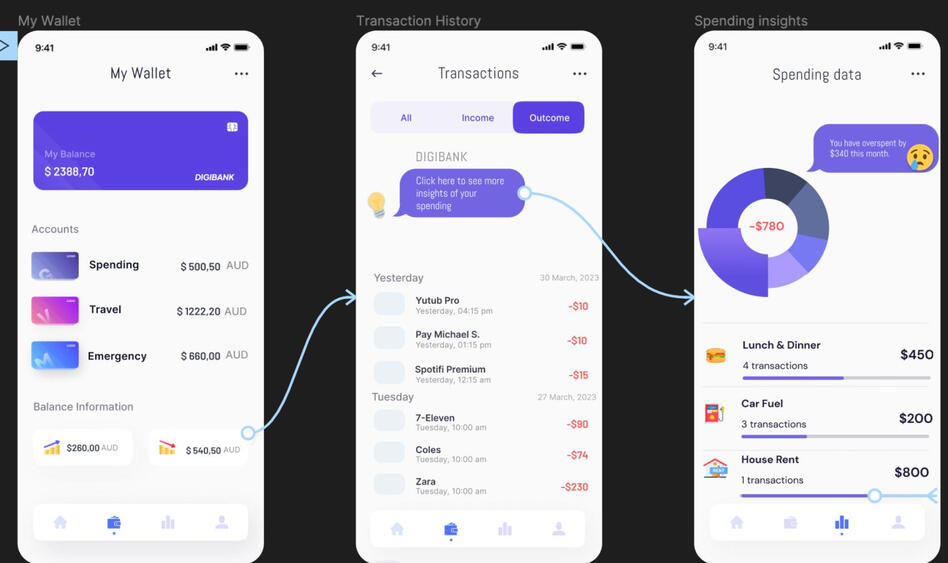
DIGIBANK - This is a hypothetical project for a Neo bank product that young Australian consumers desire. I applied the Double Diamond Design Model in order to complete the project.

Problem statement
A high proportion of young Australians are having financial difficulties and are challenging to grasp fundamental ideas about finance.
As a result, they may experience tremendous stress, financial insecurity, and an unclear future.
Solution
Delivering 2 smart banking features:- The first reveals consumer spending data and how they have strayed from their financial goals, as well as recommendations and ideas to reduce their overspending.- The second function allows customers to select Round-up and have the round-up amount automatically deposited into their savings accounts.
METRICS
- Reach 80% of customer satisfaction by in-app surveying targeting the improvement features.
- Increase Smart Banking feature usage to 20% in the 1st quarter.
- Achieve 20% increase in users using round-up feature in the first 3 months.
PROCESS
TL;DR Version
1. Discover Phase:a. Align objectives with Digibank's vision (OKRs).b. Gather initial insights through friend interviews.c. Define problems with JTBD statements.d. Analyze competitors and create strategic canvases.e. Organize insights with an affinity map.
2. Define Phase:a. Validate hypotheses with user interviews.b. Use HCD techniques for innovative ideas.c. Develop wireframes and prototypes.
3. Develop and Delivery Phase:a. Validate solutions with hypothetical customers.b. Prioritize features with the RICE framework.c. Create user stories and epics in JIRA.d. Share updates via blog and email.e. Plan for user satisfaction, metrics analysis, testing, and refinement.
PROTOTYPE